Skip to content

Content Security Lab

  • Home
  • Watermarking & Provenance
  • Content Protection
  • Research Notes
  • Benchmarks
  • About
Content Security Lab
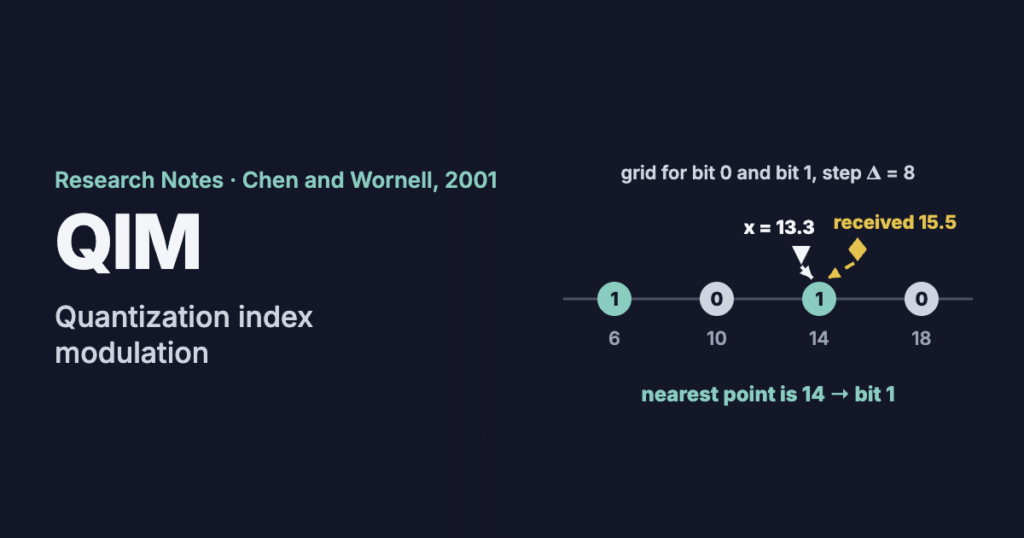
  • Card cover: Quantization Index Modulation (Chen and Wornell, 2001)
    Research Notes | Watermarking & Provenance

    Quantization Index Modulation: A Class of Provably Good Methods for Digital Watermarking and Information Embedding (Chen and Wornell, 2001)

    ByDanny November 7, 2026November 9, 2026

    Why QIM assigns messages to quantizers, how dither modulation embeds and decodes them, and what the paper’s channel analyses and our image tests report.
    Read More Quantization Index Modulation: A Class of Provably Good Methods for Digital Watermarking and Information Embedding (Chen and Wornell, 2001)Continue

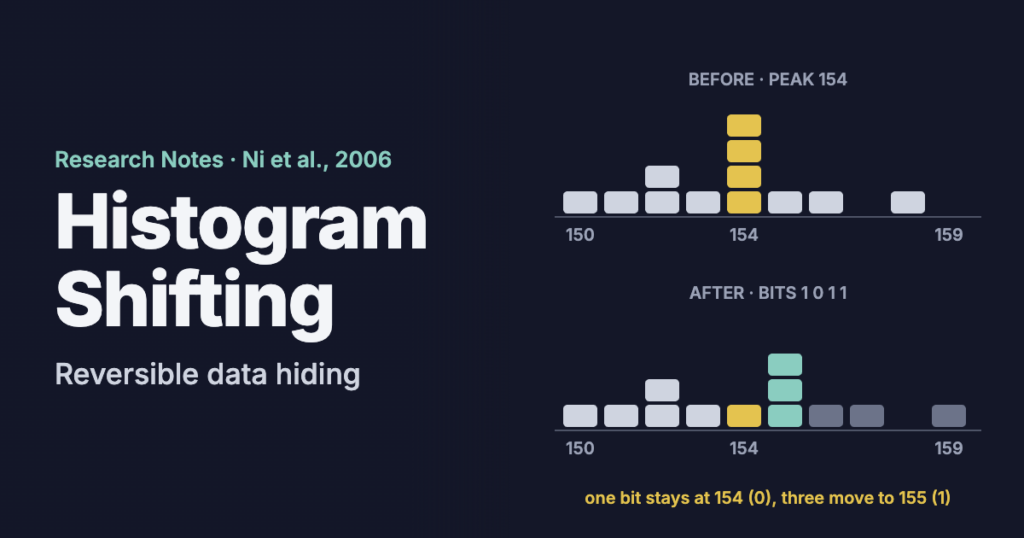
  • Card cover: Histogram Shifting (Ni et al., 2006)
    Research Notes | Watermarking & Provenance

    Reversible Data Hiding (Ni et al., 2006)

    ByDanny November 7, 2026November 9, 2026

    Why Ni et al. shift image histograms, how the decoder restores every pixel, the authors’ experiments, and our separate capacity and recovery tests.

    Read More Reversible Data Hiding (Ni et al., 2006)Continue

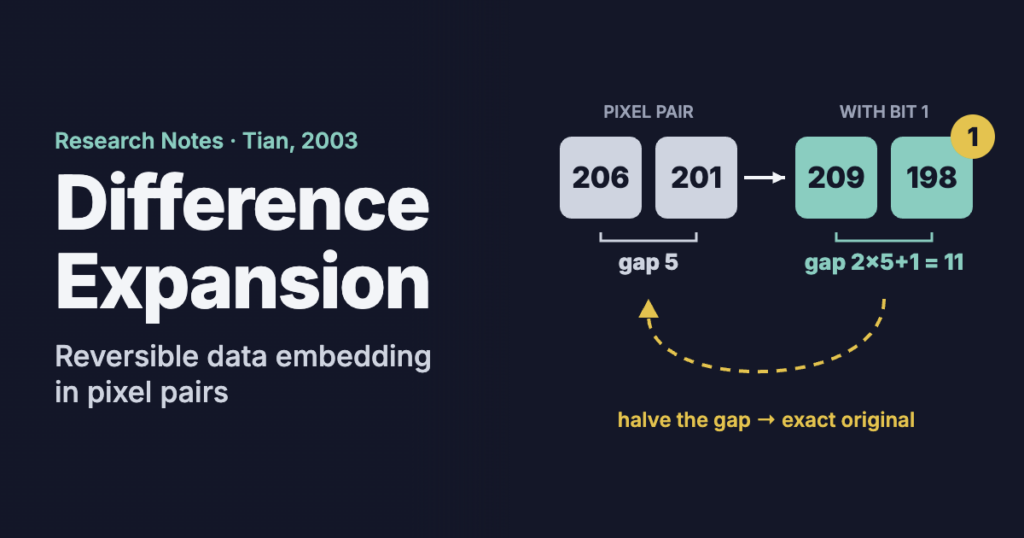
  • Card cover: Difference Expansion (Tian, 2003)
    Research Notes | Watermarking & Provenance

    Reversible Data Embedding Using a Difference Expansion (Tian, 2003)

    ByDanny November 7, 2026November 9, 2026

    Why Tian expands pixel differences, how the location map enables exact recovery, and what the paper experiments and our separate image tests report.

    Read More Reversible Data Embedding Using a Difference Expansion (Tian, 2003)Continue

  • Cover card reading EU AI Act Article 50, What engineers need to know, beside a picture tagged AI with a scan line revealing a hidden pattern.
    Content Protection | Watermarking & Provenance

    EU AI Act Article 50: What Engineers Need to Know

    ByDanny November 6, 2026November 17, 2026

    Article 50 has applied since 2 August 2026, with a targeted marking transition ending on 2 December 2026. The Act, non-binding guidelines and voluntary Code distinguish system marking, detection and deployer disclosure.

    Read More EU AI Act Article 50: What Engineers Need to KnowContinue

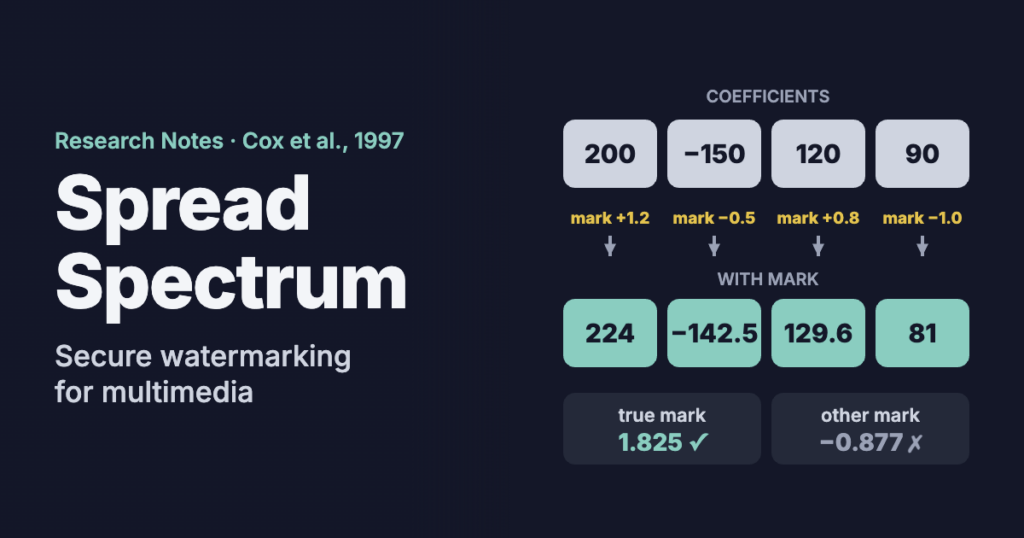
  • Card cover: Spread Spectrum (Cox et al., 1997)
    Research Notes | Watermarking & Provenance

    Secure Spread Spectrum Watermarking for Multimedia (Cox et al., 1997)

    ByDanny November 6, 2026November 9, 2026

    Why Cox et al. mark large image-frequency coefficients, how their original-image detector decides, and what their experiments and our Airplane and Boat tests report.

    Read More Secure Spread Spectrum Watermarking for Multimedia (Cox et al., 1997)Continue

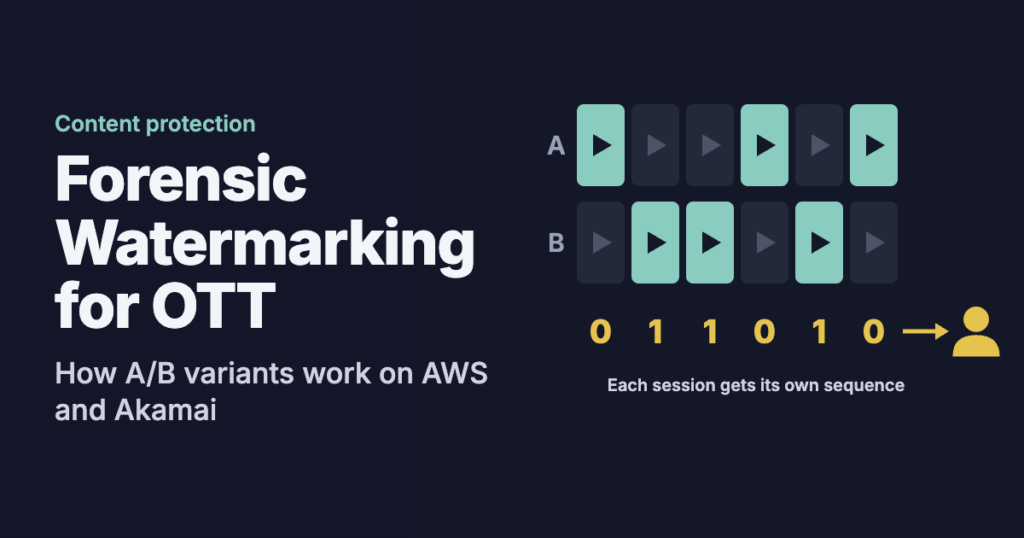
  • Cover card reading Forensic Watermarking for OTT, beside A and B video segments whose selection forms a bit sequence leading to one viewer.
    Content Protection | Watermarking & Provenance

    Forensic Watermarking for OTT: How A/B Variants Work, and How to Run Them on AWS and Akamai

    ByDanny November 5, 2026November 17, 2026

    A/B watermarking traces a leaked stream to its session without encoding a copy per viewer. How the variants, tokens, and edge logic work, with the DASH-IF specification, AWS, and Akamai.

    Read More Forensic Watermarking for OTT: How A/B Variants Work, and How to Run Them on AWS and AkamaiContinue

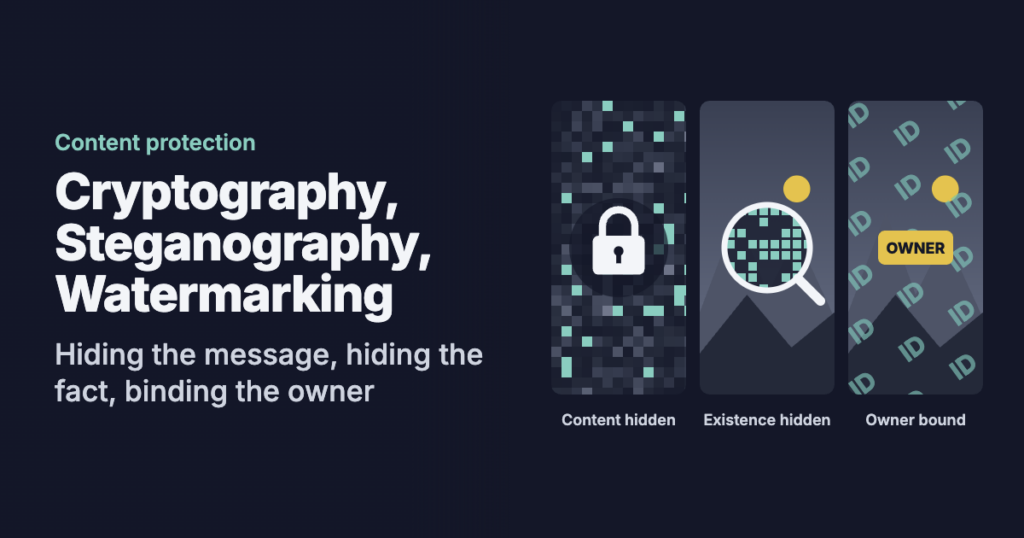
  • Cover card reading Cryptography, Steganography, Watermarking, beside three versions of one picture: locked and scrambled, hidden data under a magnifier, and marked with an owner ID.
    Content Protection | Watermarking & Provenance

    Cryptography, Steganography, and Watermarking: Hiding the Message, Hiding the Fact, Binding the Owner

    ByDanny November 4, 2026November 17, 2026

    Cryptography hides what a message says. Steganography hides that a message exists. Watermarking binds information to content so it is hard to remove. Same toolbox, three different adversaries.

    Read More Cryptography, Steganography, and Watermarking: Hiding the Message, Hiding the Fact, Binding the OwnerContinue

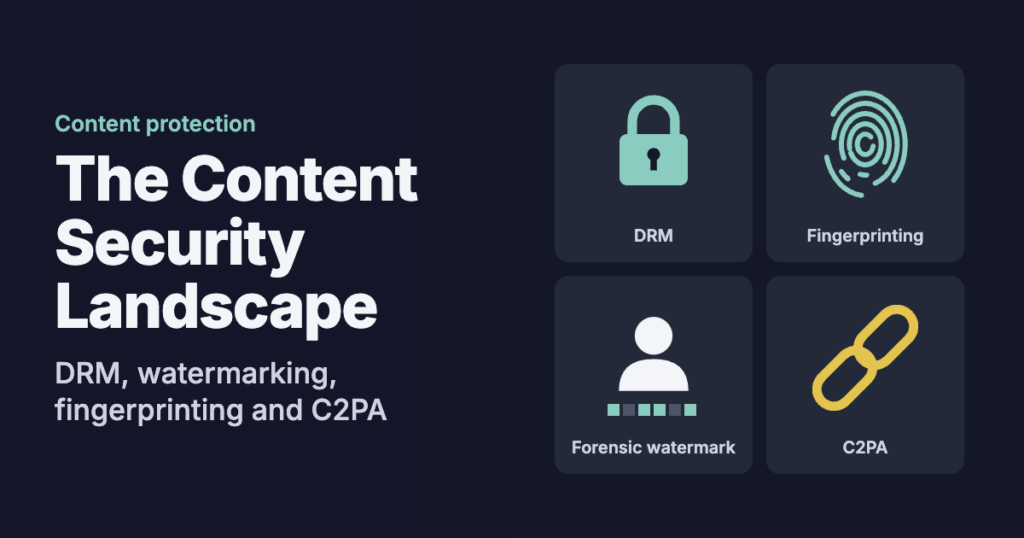
  • Cover card reading The Content Security Landscape, beside four tiles: a lock for DRM, a fingerprint, a person with a bit pattern for forensic watermarking, and a chain for C2PA.
    Content Protection | Watermarking & Provenance

    The Content Security Landscape: DRM, Watermarking, Fingerprinting, and C2PA

    ByDanny November 4, 2026November 17, 2026

    Content security isn’t one technology. It’s four tools answering four different questions: who can play it, is this ours, who leaked it, and where did it come from.

    Read More The Content Security Landscape: DRM, Watermarking, Fingerprinting, and C2PAContinue

Page navigation

Previous PagePrevious 1 2

© 2026 Content Security Lab · Dae Soo Kim

  • Home
  • Watermarking & Provenance
  • Content Protection
  • Research Notes
  • Benchmarks
  • About