EU AI Act Article 50: What Engineers Need to Know
TL;DR
- Current law. EU AI Act Article 50 has applied since 2 August 2026. Article 111(4), added by the Digital Omnibus on AI, gives providers of qualifying generative systems placed on the market before that date until 2 December 2026 to meet Article 50(2).
- Different parties, different duties. AI system providers handle machine-readable marking and detectability under the Act; deployers disclose deep fakes and specified public-interest text. Article 50(5) sets requirements for timing, clarity and accessibility.
- Four technical qualities. Article 50(2) requires effective, interoperable, robust and reliable solutions as far as technically feasible, taking account of content limitations, implementation costs and the generally acknowledged state of the art.
- The voluntary Code. Section 1 specifies signed metadata and imperceptible watermarking, with stated exceptions and alternatives. Fingerprinting, logging and forensic detection are optional supplementary measures. Section 2 covers deployer labels.
- Legal status. The Act is binding law. The Commission guidelines are non-binding. The Code is voluntary; adherence does not conclusively establish compliance or grant a presumption of conformity.
- Watermark threats. Test whether attackers can remove or transfer the mark, and whether detector queries help them. Check the complete detection decision on unmarked content, reconcile metadata with watermark results, and measure performance across content lengths, delivery platforms and provider pipelines. Marking can reduce factual accuracy and mislead deepfake detectors.
The dates now in force
As of 6 November 2026, the Digital Omnibus on AI is enacted law. Regulation (EU) 2026/1744 is dated 8 July 2026 and was published on 24 July; under its Article 4, it entered into force on the third day after publication, 27 July 2026. The current AI Act consolidation is dated 27 July 2026.
The general application date remains 2 August 2026 in Article 113. For providers of AI systems, including general-purpose AI systems, that generate synthetic audio, images, video or text and were placed on the market before 2 August 2026, the new Article 111(4) creates a targeted transition: those providers shall take the necessary steps to comply with Article 50(2) by 2 December 2026. Only this marking and detection duty gets the extension; the rest of Article 50 is not postponed.
The Commission’s policy page records publication of the final voluntary Code on 10 June 2026; the publication record for its non-binding guidelines is dated 20 July 2026.
Who owes what
A person, authority, agency or other body is a provider under Article 3(3) if it develops, or has developed, an AI system or general-purpose AI model and places it on the market, or puts the system into service, under its own name or trademark. Payment is not required. A deployer uses an AI system under its authority, except for personal non-professional activity (Article 3(4)).
The duties in Article 50 depend on the party and the use of the system, with statutory exceptions and qualifications:
| Party | Duty | Qualification | |
|---|---|---|---|
| 50(1) | Provider | Design direct-interaction systems to inform people that they are interacting with AI. | Except where obvious to a reasonably well-informed, observant and circumspect person in context. Specified legally authorised criminal-law systems are excepted, subject to safeguards, unless available for public crime reporting. |
| 50(2) | Provider | Mark synthetic audio, image, video and text outputs in a machine-readable format and make them detectable as artificially generated or manipulated. | Assistive standard editing, non-substantial alterations and specified legally authorised criminal-law uses are excepted. |
| 50(3) | Deployer | Inform people exposed to emotion recognition or biometric categorisation of the system’s operation; process personal data under the applicable data-protection laws. | Specified legally permitted criminal-law uses are excepted, subject to safeguards and Union law. |
| 50(4) | Deployer | Disclose artificial generation or manipulation of deep fakes and text published to inform the public on matters of public interest. | Specified legally authorised criminal-law uses are excepted. Artistic works have a limited disclosure regime. Public-interest text has the review and editorial-responsibility exception described below. |
People must receive the information in paragraphs 1 to 4 no later than first interaction or exposure. It must be clear and distinguishable and meet applicable accessibility requirements (Article 50(5)). For Article 50(2) detection results, first exposure means the point when a person seeks to verify a piece of content and accesses the detection solution, according to the non-binding guidelines, paragraph 77.
Systems and models are distinct
General-purpose AI systems are expressly included in Article 50(2). General-purpose AI models are not explicitly covered by Article 50, a distinction drawn in the non-binding guidelines, paragraphs 26-27.
Marking can be implemented at system or model level to facilitate the downstream system provider’s duty (Recital 133). Guidelines paragraph 27 discusses model-level implementation and encourages other model providers to support downstream transparency. Even when marking comes from upstream or a third party, the system provider remains responsible for demonstrating compliance, as guidelines paragraph 74 states.
General-purpose AI model providers have their own duties in Article 53, paragraph 1: model technical documentation, information for downstream system providers, a copyright policy and a public summary of training content. Article 50 addresses system transparency.
What Article 50(2) requires
Outputs must carry machine-readable marking and be detectable. The technical solutions must be effective, interoperable, robust and reliable, as far as technically feasible. Providers must consider the specificities and limitations of different content types, implementation costs and the generally acknowledged state of the art, as potentially reflected in relevant technical standards.
Marking alone is insufficient if no means of detection is available: the non-binding guidelines, paragraphs 69-70, treat them as distinct but linked elements. Providers need not retain a full provenance chain (paragraph 73). For full interoperability, paragraph 76 says providers must rely on publicly available industry-standard detection solutions. Where such standards are not available, especially at the initial stage for watermarking, a provider may use its own, a third-party or a shared detection solution, so long as it is interoperable with those of other providers.
Systems are excepted to the extent that they assist standard editing or do not substantially alter the deployer’s input data or its semantics. The Act excepts the specified legally authorised criminal-law uses too. Standard editing, as described in the non-binding guidelines, paragraphs 90-92, prepares existing content for publication or distribution without generating new content: grammar correction, technical compression, noise reduction and minor cropping are examples. Summaries, substantive rewriting and object or person replacement that changes meaning or substance fall on the other side of that distinction. The exception applies to minor alterations even where a system supports generation or substantive manipulation (paragraph 92).
Short sequences of numbers, symbols or letters, such as single words, alt text and UI labels, fall outside Article 50(2) according to the non-binding guidelines, paragraphs 67-68. So does source code, including SDKs, SQL, infrastructure-as-code and YAML or JSON configuration. The same applies to machine-to-machine outputs with no human exposure and outputs used only in closed-loop industrial and product development workflows. In those workflows, only the final AI-generated or manipulated text, audio, image or video output has to be marked and detectable.
The Code’s marking layers
Watermarks, metadata identifications, cryptographic provenance and authenticity methods, logging, fingerprints and other techniques, including combinations, appear in Recital 133. Section 1 of the voluntary Code turns that list into commitments for signatories. All Code measure numbers in this and the next three sections refer to Section 1, Providers.
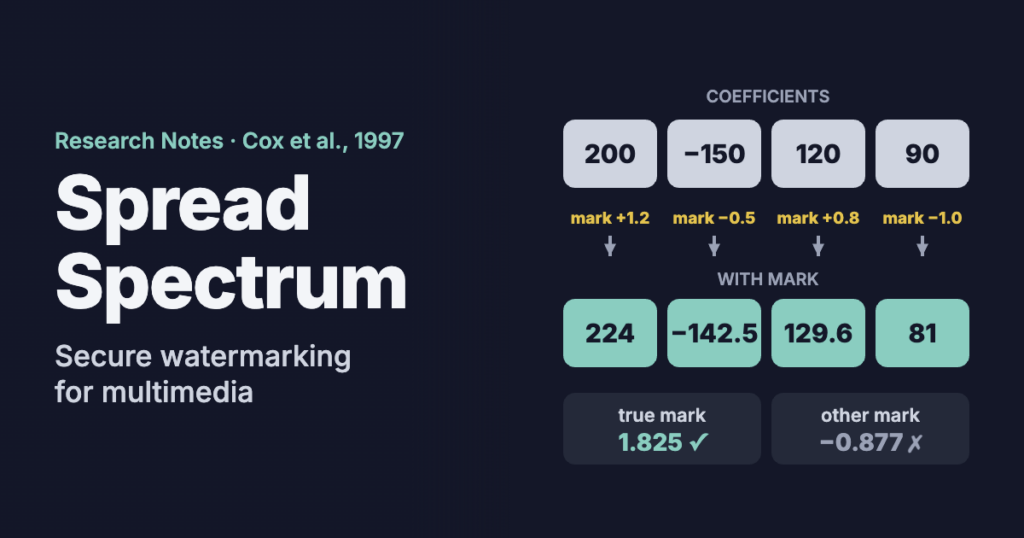
Signatories will use at least one machine-readable technique whose marking and detection meet the four qualities (Measure 1.1). While one technique cannot meet them alone for audio, images, video and containerised text, at least two layers are needed: metadata and watermarking. Alternatives are allowed if demonstrated through recognised evaluation methods and benchmarks. Until those methods are available, the Code permits documented internal testing, subject to authority review.
| Code provision | Signatory measure | |
|---|---|---|
| Signed metadata | Sub-measure 1.1.1 | Record whether content is AI-generated or manipulated when its generated, manipulated or exported format supports metadata. Digitally sign the recorded information and timestamp it where time information is available. Protect certificates and private keys; this requirement is qualified where the deployment context cannot support secure key handling or provisioning. |
| Imperceptible watermark | Sub-measure 1.1.2 | Embed a watermark that is difficult to separate from the content, except for very short text. The Code discusses both post-generation watermarking and watermarking during inference. |
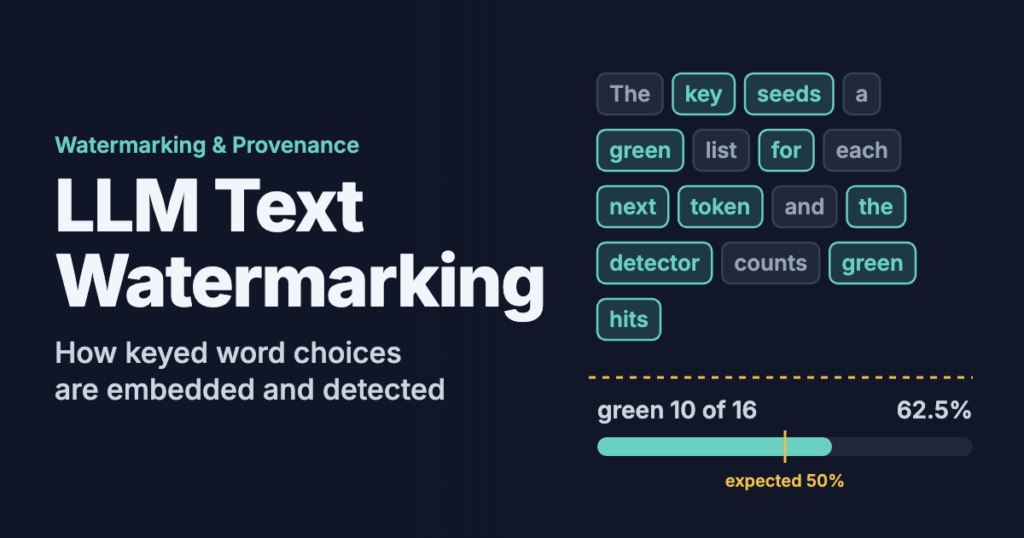
| Free-form text | Measure 1.1; Sub-measure 1.1.2 | Free-form text cannot carry metadata, so the Code considers a single watermark layer sufficient. Watermarking still applies to text longer than 200 tokens, despite potentially lower reliability than for very long text. |
| Fingerprinting or logging | Sub-measure 1.1.3, optional | Supplement other techniques. The Code says these alone are insufficient for its quality requirements. Logging is limited to outputs, with privacy, security, retention and user-control conditions; it creates no general commitment to retain prompts or user interactions. |
| Richer provenance | Measure 1.3, optional | Add context such as system and provider names, generation time, model identifier and version, or the type of manipulation. |
Certain physical products operating in technically controlled, closed, mainly instructive environments may use a single layer under Measure 1.1, provided effective technical measures prevent outputs from leaving that environment, including through capture or export.
When processing inputs, signatories will make best efforts to preserve existing metadata markings, where technically feasible and recognisable through open standards (Measure 1.2). Legitimate transformations needed for accurate, functional metadata and specified legitimate processing remain allowed. Policies, terms or documentation will prohibit intentional removal or tampering, with those exceptions; for free and open-source systems and models, alerting users in documentation is sufficient under this measure. Signatories will refrain from marketing or promoting tools whose purpose is to circumvent transparency markings.
Detection access and forensic detection
Every implemented marking technique needs a way to detect it (Measure 2.1). That can be specifications, software, cloud APIs or a combination under Sub-measure 2.1.1. Access is free by default, though signatories with fewer than 1,000,000 monthly users and substantial detection costs may charge reasonable, fair, proportionate fees above a reasonable per-user high-volume threshold. Listed authorities, media, fact-checkers, trusted flaggers, independent researchers, educational and research institutions, and civil society organisations retain unlimited free access.
Public exposure calls for public access under Sub-measure 2.1.2; effective limited-audience safeguards can support restricted access. For less reliable, less robust free-form text watermarks, access may temporarily be exclusive to verified expert users with a legitimate need, with safeguards, pending improved mechanisms. Requested results are downloadable and digitally signed, with a content hash, detector identifier and timestamp.
Forensic detection of content whose markings have been stripped is optional (Measure 2.2). The Code calls it insufficiently mature at publication to meet its quality requirements and permits expert-only results while that remains so. Signatories will make detection results clear and accessible and, where technically feasible, identify their basis: metadata, watermark, forensic detection or another technique (Measure 2.3).
Four qualities and their tests
Quality is assessed across the combined marking and detection solution in Section 1, Commitment 3. Individual techniques need not each satisfy every quality.
| Measure | What the Code specifies | |
|---|---|---|
| Effectiveness | 3.1 | People can access and understand detection results. Assessment is user-based, with no quantitative metric. |
| Reliability | 3.2 | Assess accuracy under unaltered conditions and variation across content length, size, diversity and semantics. Use relevant metrics such as detection error rate, with marked outputs and other content. Assessment data should, to the extent possible, be separate from training and development data. |
| Robustness | 3.3 | Assess common alterations and adversarial attacks using the reliability metrics. Listed operations include recompression, screenshots, cropping, scaling, paraphrasing, translation cycles, print-and-scan and playback/recording. Listed malicious behaviour includes copying, removal, regeneration and modification of marks. The measure excludes systems exceptionally using only a metadata layer under Measure 1.1. |
| Interoperability | 3.4 | Initially use established metadata standards or practices, publish integration and access information for other marks, and implement a watermark-detection interoperability solution by 2 February 2027. Cooperate on further solutions and implement emerging standards as specified. |
For the watermark-detection milestone in Measure 3.4, signatories can provide an interoperable industry-standard access method for routing queries and interpreting results, a readable signpost identifying the detector, an inclusive shared provider detector, or another solution with comparable interoperability. Safeguards against misuse and harm to other embedded watermarks are required. This voluntary Code milestone has its own date; Article 111(4)’s December deadline is statutory.
Those measurements sit within the processes in Section 1, Commitment 4. Signatories need an updated, documented compliance process proportionate to their size and resources (Measure 4.1), and testing under representative real-world conditions before market placement or service and regularly afterwards (Measure 4.2).
Until recognised evaluation methods and benchmarks emerge, signatories will test and report using internal benchmarks and industry practices. They may use qualifying upstream results, independent experts, red teaming or regulatory sandboxes; responsibility remains with the signatory, which will monitor substantiated shortcomings and take corrective action. Signatories will train personnel proportionately and cooperate with market surveillance authorities (Measures 4.3 and 4.4).
Threats to account for when applying a watermark
Article 50(2) asks for robust and reliable marking and detection as far as technically feasible, and Code Measure 3.3 assesses robustness against both common alterations and malicious behaviour. Most studies cited here are arXiv preprints; publication venues are listed in the References.
Removal
Removal attacks transform marked content until the detector no longer fires. For text, paraphrasing needs only freely available tools: in a small study of 50-token texts using open-source MarkLLM implementations, paraphrases that passed a validity filter defeated detection for nearly all texts the detector had initially flagged (Tamim and Khan).
Images can be laundered through public editing models. Yang et al. submitted marked images to six OpenAI and Google models with one reconstruction prompt, no key and no detector feedback. The outcome depends on scheme and model. After Nano Banana 2, at a mean PSNR of about 30 dB against the input, DwtDct stayed at a bit error rate of 0.41, where 0.5 is random recovery, while RivaGAN recovered to 0.12.
For speech, neural codec resynthesis is the main route to test. In Pauna et al., AudioSeal’s true-positive rate at 1% false-positive rate was 100% without attack and after MP3 at 32 kbps, but 1.3% after Mimi at 1.1 kbps. The training codec changed generalisation: the authors’ model trained with Mimi and SNAC augmentation reached 77.2% on NanoCodec, which was not used in that training. Include codecs held out from training.
Test removal through editing and regeneration as well as paraphrasing, using attacks plausible for the content’s distribution, as Code Measure 3.3 specifies.
Forgery
For the tested Tree-Ring and Gaussian Shading configurations, an attacker with one marked reference image and an unrelated diffusion model could transfer the mark to a different image. The imprinting attack optimises a cover image’s inverted latent representation towards the reference image’s, carrying over the watermark (Müller et al., CVPR 2025).
Measure forgery success separately from removal success: the attacker wants unrelated content accepted, not marked content rejected. Code Measure 3.3 lists copying among malicious behaviours to assess.
Provenance and watermark conflicts
An attacker can sign metadata that omits AI disclosure without changing the marked pixels. In the tested image pipeline, self-signed C2PA manifests passed cryptographic validation while the watermark still identified synthetic origin. Content Credentials Verify warned about the unrecognised issuer but did not inspect the pixel watermark (Nemecek et al., CVPR 2026 APAI workshop). The authors note that a CA-issued certificate from a C2PA-compliant tool would remove that warning and leave the contradiction undetected. Compare the metadata’s origin claims with the watermark result and report contradictions.
False positives on unmarked content
A blind BCH decoder corrects bit errors within a fixed radius of a valid codeword. Random extracted bits sometimes fall inside that radius, so successful correction alone is a poor detection rule. Across four tested TrustMark variants, 5.9%-15.3% of 85 unmarked images yielded a valid codeword on at least one of four decodes. Comparing those decodes with the expected payload, requiring 74 of 100 bits to match, produced no false matches (Kazempourradi et al.). That small sample does not establish a very low false-positive rate. Test the complete decision rule on unmarked content, including the expected-payload comparison where available.
Detector access
A binary detector gives removal a stopping rule: try edits of increasing strength and keep the first that flips the verdict. Milis et al. report that forgery stayed at chance under binary feedback. Returning p-values exposes more: in the same text detectors, an attacker inverts the null distribution to recover aggregate scores, then subtracts the scores from queries with and without a token to estimate its contribution. For word edits, removing a token also re-seeds the contexts that follow it, so the estimate is noisy. Evaluate attacks against the feedback your interface actually returns. Both attacks spend detector queries, and the authors note that rate limits can constrain them.
Short text and code
When the next-token distribution is concentrated on one token, a distortion-free sampler has little choice with which to encode a statistical mark. Short outputs supply fewer scored tokens. The open-source, non-distortionary SynthID-Text configuration tested with English prompts and a mean g-value detector showed improving prose detection with length; code stayed near chance across attained lengths (Nemecek et al., September 2026). Guidelines paragraph 68 places source code and short label-like sequences outside Article 50(2), so settle which outputs are in scope before setting these tests. Report true-positive rate at a fixed false-positive rate, separately by content type and length, with the operating threshold stated.
Cross-provider detection
Text detectors usually read the signal through the generator’s own tokenizer or embedding pipeline, so adopting one scheme across providers does not make the marks mutually readable. In Wang and Li’s tests, sentence-level methods exceeded 90% true-positive rate with their own embedding model and averaged 4%-9% with a replacement. Searching over candidate tokenizers has its own cost: the false-positive rate rose to several times the single-test rate, so the combined decision needs calibration. The authors use Bonferroni correction for this and note that it can reduce power. When building toward Code Measure 3.4’s interoperability milestone, test generator and tokenizer mismatches, and calibrate the false-positive rate over the whole search.
Processing and platform drift
Exercise the delivery pipeline’s ordinary transformations; Code Measure 3.3 includes recompression and cropping. Compare decoded payloads across detection platforms. In Kazempourradi et al.’s cross-device test of 12 Video Seal clips and one TrustMark-Q image, identical decoded YUV frames became different RGB inputs on x86-64 and arm64 hosts; platform-specific colour conversion flipped up to two of 256 payload bits in two Video Seal clips, both marked at strength 1.1. The authors recommend portable, fully specified YUV-to-RGB conversion or detection on YUV input when identical bits are required across platforms.
Side effects of marking
Text watermarks can cost factual accuracy. In a controlled retrieval-augmented setup, Ye et al. report a net factual accuracy decrease of 12.9%-14.4% for KGW and 2.4%-2.9% for a SynthID-style method across three models, at 0.90 true-positive rate and 1% false-positive rate. The decrease grew with watermark strength. Measure factual accuracy on your own tasks at the strength you intend to ship.
Downstream classifiers can learn the mark as a shortcut. Müller and Debus (Fraunhofer AISEC and Resemble AI) trained an audio deepfake detector on data where only the fakes carried a watermark. On watermarked real speech it reached a 75% equal error rate, against 16% for a detector trained on clean audio. Adding a watermark to real speech moved a commercial detector towards a fake verdict too. Training with the watermark on both classes removed the shortcut. If a deepfake detector will see marked content, evaluate it with marks on real and fake samples.
Binding law, guidance and standards
The AI Act and its Omnibus amendment are binding legislation. Their authentic instruments are published in the Official Journal; the consolidated text is a documentation tool. The Commission guidelines are non-binding, as paragraph 5 states.
Adherence to the voluntary Code does not constitute conclusive evidence of compliance, as the Commission’s assessment announcement and both Code sections state. The announcement records the Commission’s adequacy conclusion on 8 July 2026 and the AI Board’s assessment the next day. These codes do not grant a presumption of conformity (Omnibus recital 41). Current Article 50(7) provides for adequacy assessment and retains a power to specify common rules by implementing act if a code is inadequate.
Neither C2PA nor ISO 22144 is named in the final Code text; its interoperability measures refer to standards and practices without naming either. C2PA’s 30 July 2026 guide, version 1.0, describes Content Credentials for synthetic and non-synthetic content. Its abstract identifies the document as guidance, not normative requirements.
CEN-CENELEC’s 15 October 2026 announcement links EN 18286:2026 to the Article 17 quality management system for high-risk AI systems; the cited standard concerns that system and does not address Article 50 content marking. ISO’s catalogue listed ISO/CD 22144, Authenticity of information: Content credentials, as under development on 6 November 2026.
Deployer disclosure and labels
A deep fake is AI-generated or manipulated image, audio or video that resembles existing persons, objects, places, entities or events and falsely appears authentic or truthful (Article 3(60)). Deployers must disclose its artificial generation or manipulation under Article 50(4). For evidently artistic, creative, satirical, fictional or analogous works or programmes, disclosure is limited to an appropriate form that does not hamper display or enjoyment. The statutory criminal-law exception applies here too.
For text published to inform the public on matters of public interest, the exception in Article 50(4) has two conditions: human review or editorial control has occurred, and a natural or legal person holds editorial responsibility for publication.
The measure numbers start again in the voluntary Code’s Section 2, Deployers. Label design uses an EU icon or equivalent label with the capitalised acronym AI as the main visual element, subject to the national-language qualification (Measure 1.1). Audible disclosure is covered where visual disclosure is unavailable, as are accessible alternatives including screen-reader compatibility.
Labels need to be immediately recognisable without interaction or sustained attention, remain visible long enough, and be embedded or supplied through equivalent alternatives such as a user-interface overlay (Section 2, Measure 1.2). For video, disclosure comes at the beginning, where possible at intervals, and at least after interruptions. Text labels may sit near the headline or at the beginning; contextual notices are permitted for very short text where direct labels impair usability. Audio-only content has an initial audible disclosure and, where appropriate, reminders.
Signatories will keep internal documentation, maintain personnel awareness, review substantiated labelling problems and correct them under Section 2, Commitment 2. Artistic-work disclosure can take account of context, including through adjacent interface elements perceivable without dedicated user action (Commitment 3).
For review and editorial control, qualifying media providers may rely on existing procedures. Other signatories establish or maintain proportionate policies identifying editorial responsibility and the resources for review before publication (Commitment 4). Records of every individual text review are not required.
Territorial reach and open source
Providers placing systems on the Union market or putting them into service there, and providers placing general-purpose models on that market, fall within Article 2(1)(a)-(c) regardless of establishment. It covers deployers established or located in the Union, as well as third-country system providers and deployers where the system’s output is used in the Union.
Free and open-source AI systems are excluded from the Regulation by Article 2(12) unless they are placed on the market or put into service as high-risk systems or systems falling under Article 5 or 50. The non-binding guidelines, paragraphs 23-24, draw a distinction between Article 50 systems and open-source components: software, data, models, tools, services and customisation or integration processes that do not themselves constitute an AI system are not subject to Article 50 transparency duties. The guidelines encourage proportionate and feasible support for downstream transparency.
Penalties and enforcement
Breaching Article 50’s transparency duties falls expressly under Article 99(4)(g). The maximum administrative fine in paragraph 4 is EUR 15 million or, for an undertaking, 3% of total worldwide annual turnover in the preceding financial year, whichever is higher. SMEs, including start-ups, get the lower of the relevant monetary or percentage ceilings under Article 99(6). Small mid-cap enterprises get the lower ceiling for paragraphs 4 and 5 under Article 99(6a). Member States must take into account the interests and economic viability of SMEs, including start-ups, and small mid-caps when imposing penalties (Article 99(1)).
National competent market surveillance authorities are the principal enforcers, according to the Commission FAQ. For specified systems based on general-purpose models developed by the same provider or providers within the same undertaking, current Article 75(1) gives the AI Office exclusive competence, subject to listed exclusions. That competence extends to systems constituting or integrated into designated very large online platforms or search engines.
The same-provider category excludes Annex I product-related systems, Annex III point 2 systems, the specified law-enforcement, border-management and financial-institution systems under Article 74(6), and Annex III point 8 administration-of-justice systems. Article 75 extends the Office’s competence to deployers only when they are also the provider or part of the provider’s undertaking.
References
- European Parliament and Council, “Regulation (EU) 2024/1689, AI Act,” 13 June 2024, recital 133; consolidated text, 27 July 2026, Articles 2, 3, 50, 53, 75, 99, 111 and 113.
- European Parliament and Council, “Regulation (EU) 2026/1744, Digital Omnibus on AI,” 8 July 2026, published 24 July 2026, recital 41 and Articles 1 and 4.
- “Code of Practice on Transparency of AI-Generated Content,” final Code, published 10 June 2026, Sections 1 and 2.
- European Commission, “Code of Practice on Transparency of AI-Generated Content,” process and voluntary status, updated 19 October 2026.
- European Commission, “Commission opinion on the assessment of the Code of Practice,” published 9 July 2026, updated 31 July 2026.
- European Commission, “Guidelines on transparency obligations for providers and deployers of AI systems,” C(2026) 5054 final, 20 July 2026; publication record updated 5 November 2026.
- European Commission, “Transparency obligations under Article 50 of the AI Act,” FAQ, updated 24 July 2026.
- C2PA, “Use of Content Credentials to Identify Synthetic and Non-Synthetic Content,” version 1.0, 30 July 2026.
- CEN-CENELEC, “First ever European standard on AI published in the OJEU,” 15 October 2026.
- ISO, “ISO/CD 22144, Authenticity of information: Content credentials,” undated catalogue record, checked 6 November 2026.
- Andreas Müller, Denis Lukovnikov, Jonas Thietke, Asja Fischer and Erwin Quiring, “Black-Box Forgery Attacks on Semantic Watermarks for Diffusion Models,” arXiv version, December 2024; CVPR, June 2025, DOI.
- Georgios Milis, Tom Sander, Tomáš Souček, Heng Huang and Pierre Fernandez, “Could LLM Watermark Detection be Public?,” arXiv preprint, October 2026.
- Alexander Nemecek, Hengzhi He, Guang Cheng and Erman Ayday, “Authenticated Contradictions from Desynchronized Provenance and Watermarking,” arXiv version, March 2026, revised October 2026; CVPR 2026 Workshop Authenticity & Provenance in the Age of AI (APAI).
- Seyedmahdi Kazempourradi, Ramtin Mojtahedi and Behrang Mohseni, “Watermarks and Fingerprints as Soft Bindings for Content Provenance: An Open-Licence Benchmark for Images, Audio and Video,” arXiv preprint, October 2026.
- Saifur Rahman Tamim and Amir Labib Khan, “AI Watermark Evidence Fails Forensic Readiness: An Empirical Evaluation,” arXiv preprint, July 2026.
- Alexander Nemecek, Vipin Chaudhary and Erman Ayday, “Watermarks Without Verification: AI Text Watermarking After the EU AI Act,” arXiv preprint, September 2026.
- Jidong Yang, Qi Li, Wei Zong, Yang-Wai Chow, Willy Susilo, Huaike Yu, Chunpeng Wang and Suo Gao, “One Prompt Is Enough: Watermark Laundering Through Foundation Image Models,” arXiv preprint, September 2026.
- Olli-Pekka Pauna, Xin Wang and Lauri Juvela, “Cross-Codec Robustness in Speech Watermarking,” arXiv preprint, November 2026.
- Xiaopu Wang and Runze Li, “ByteMark: A Unified Byte-Level Watermark for Detection Across Language Models,” arXiv preprint, October 2026.
- Haocheng Ye, Aoting Hu, Xinwei Zhang, Xunzhu Tang, Shuchao Pang and Jason Xue, “Invisible Ink, Visible Lies: How Production Watermarking Causes LLMs to Hallucinate,” arXiv preprint, October 2026.
- Nicolas M. Müller and Pascal Debus, “The Watermark Shortcut: How Provenance Marking Sabotages Audio Deepfake Detection,” arXiv version, June 2026, revised August 2026.