The watermarks big tech chose for AI content
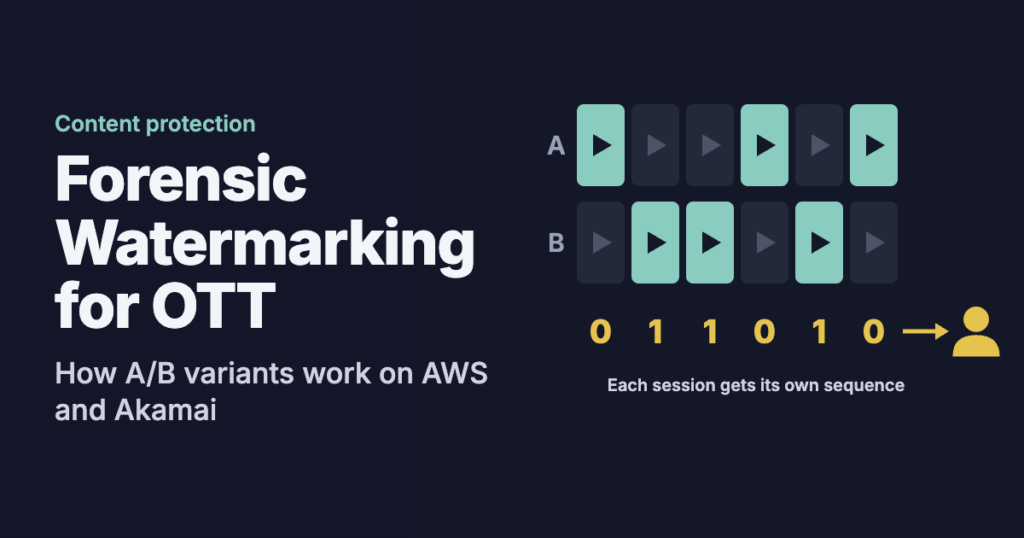
Brightcove describes forensic watermarking as a way to trace a content leak through a token linked to a viewer. Google describes SynthID as identifying AI-generated content. The signal can occupy similar media while referring to different events: a distribution session or a generation operation.
A third role connects a distributed file to a provenance record. C2PA’s implementation guidance describes recovering a missing manifest through a watermark identifier. For content-protection engineering, the resulting evidence involves the embedded signal, the detector’s output and the record associated with that output.
TL;DR
Google extends SynthID across four media and external partners; Meta separates open research models from proprietary production image marking; Amazon described generation and detection within Bedrock; Adobe’s TrustMark carries a lookup identifier. We measured TrustMark v0.9.2 Q and VideoSeal v1.0 on 500 COCO val2017 images: both reached 100% detection after JPEG quality 30, resizing to 1/4 and Gaussian blur with sigma 2. Cropping to 50% of image area left detection at 27.8% and 98.2%, respectively; at 25% area it fell to 0.2% and 3.0%.
We measured 20 same-method embeddings without distribution edits: image PSNR fell from about 41 dB to about 25.5 dB for TrustMark and 28 dB for VideoSeal. Latest-ID bit accuracy stayed around 99.8%, while previous-ID accuracy was around 50% from the second embedding. We propose a verification layer that records each detector’s identity, version, run status, presence result, message and segment alongside C2PA validation and provenance-record matches.
Why the role of watermarking is expanding
Forensic watermarking connects a recovered signal with distribution records. In Brightcove’s workflow, a viewer-linked token supplies the association. Broadcast systems can instead mark distribution paths: NexGuard’s Ericsson announcement describes identifiers embedded in satellite or fibre linear-TV feeds to identify illegally redistributed signals. The recovered identifier refers to the recorded delivery path or token; identifying the person who performed a leak requires evidence beyond that association.
AI watermarking connects a signal with the generating system. Google’s SynthID description covers images, video, audio and text. A matching detector searches for the signal introduced by the supported generator or marking configuration. This is the content-identification role: the result concerns generation, including supported AI edits to existing material.
Provenance linking uses an identifier to retrieve an external record. In C2PA’s durable-credentials workflow, an invisible watermark can reconnect content to a stored manifest after embedded metadata disappears. A fingerprint can additionally compare content with the candidate record.
EU AI Act Article 50(2) requires providers of systems generating synthetic audio, images, video or text to make outputs machine-readably marked and detectable as artificially generated or manipulated. The provision qualifies effectiveness, interoperability, robustness and reliability by technical feasibility. It includes exceptions concerning standard editing or insubstantial changes and authorised law-enforcement uses. General application begins on 2 August 2026. Article 111(4) gives covered generative systems placed on the market before that date until 2 December 2026 to comply with Article 50(2).
Korea’s Ministry of Science and ICT states that the AI Basic Act and Enforcement Decree entered into force on 22 January 2026, including Article 31 transparency obligations. Its labelling-guidelines announcement describes generative-output transparency and at least a one-year grace period for investigations and penalties.
Four companies, four strategies
The four approaches differ in media coverage, deployment and access to the matching detector.
| Company | Technology | Media marked | Strategy | Detector access |
|---|---|---|---|---|
| SynthID | Image, video, audio, text | Named Google products and external partners | Public media portal; separately configured text detectors | |
| Meta | Content Seal; modality-specific research models | Muse Image production images; image/video/audio/text research | Proprietary service implementation alongside open research | Muse Image identification service; public research models |
| Amazon | Titan/Nova invisible marks; C2PA on specified Nova versions | Historical Titan/Canvas images and Reel video | Generation-time marking within Bedrock | Historical Titan console and detection API preview |
| Adobe | TrustMark and Content Credentials workflows | Images | Embedded identifier for provenance-record lookup | Open-source decoder and credential lookup tools |
Google: SynthID across media and outside Google
Google’s image watermark is an invisible signal in pixels, according to its SynthID image launch. Its video and text announcement describes marking pixels in every generated Veo frame. Google says image and video signals tolerate operations including cropping, filtering, frame-rate changes and lossy compression, within the limits of the relevant implementation and transformation.
Audio carries an inaudible signal. Google’s Lyria announcement describes converting audio to a spectrogram to add the watermark and detecting it throughout a track. Its SynthID overview claims resilience to added noise, MP3 compression and speed changes.
Text uses statistical choices during generation. Google’s developer documentation describes changing logits, the scores assigned to candidate next tokens, through a watermarking configuration. Detection depends on a compatible configuration and detector. The documentation permits models sharing a tokeniser to share a watermark configuration and detector when detector training includes all participating models.
Google says short factual answers and low-variation text offer fewer opportunities to carry the pattern. Mild paraphrasing and small edits can preserve it, while thorough rewriting or translation reduces confidence. Han et al.’s SynthID study reports degradation under paraphrasing, copy-paste modification and back-translation in the studied configurations.
Deployment extends beyond Google. OpenAI’s provenance announcement says images from ChatGPT, Codex and the API carry SynthID and C2PA Content Credentials. Its 31 July 2026 update added SynthID to supported ChatGPT/API audio and image/audio verification API access. NVIDIA’s Cosmos3 Nano system card specifies SynthID for generated images and video in its hosted Preview API, excluding numeric action arrays.
Kakao’s 20 May 2026 announcement describes planned second-half-2026 application to Kanana-Kollage images and Kanana-Kinema videos, initially targeting Kanana Template in KakaoTalk. Google’s partner announcement names OpenAI, Kakao and ElevenLabs alongside NVIDIA.
Google’s public SynthID Detector announcement describes an English-language portal for images, video and audio from Google, OpenAI, NVIDIA, Kakao and Apple. It opened globally on 7 October 2026. The original Detector launch describes scanning uploaded content for presence and highlighting likely marked portions, explicitly audio segments and image regions. It does not describe a public payload-decoding interface for those uploads.
Detector coverage also depends on the interface. Gemini’s help documentation describes recognition of Google-generated content and warns that repeated alterations can prevent detection. Google’s Reimagine announcement also acknowledges that very small edits can supply too little signal for marking and detection.
Meta: open research models, private service implementation
Meta’s Content Seal repository presents a framework covering image, video, audio and text. It explicitly describes Muse Image’s production Content Seal Image implementation as custom and proprietary.
Meta’s Muse Image launch says images generated in the Meta AI app and meta.ai include Content Seal and provides a public identification service. Meta claims the signal remains detectable after cropping, compression, resizing and screenshots. The same announcement describes video coverage as a planned extension.
The research VideoSeal repository includes PixelSeal for images and VideoSeal for video. VideoSeal v1.0 decodes a 256-bit message; v0.0 used 96 bits. The repository describes a global watermark-strength parameter, scaling_w, with a default of 0.2: increasing it raises robustness and visibility, while reducing it improves imperceptibility.
AudioSeal’s repository separates localised audio detection from optional message recovery. TextSeal is a research toolkit covering generation-time marking, rephrasing-based post-hoc marking and contamination detection, including localised detection and a dual-key generation-time model.
Meta’s platform-labelling announcement describes AI labels on Instagram, Facebook and Threads.
Amazon: marking and checking inside Bedrock
AWS’s Titan Image Generator announcement says generated images received an invisible watermark by default. Its 23 April 2024 release provided generally available console detection and the DetectGeneratedContent API in public preview in us-east-1 and us-west-2. The example API response exposes detectionResult and confidenceLevel, including GENERATED with HIGH confidence and a separate NOT_GENERATED example.
AWS says image transformations can reduce confidence even when Titan generated the image.
Amazon Science’s Nova account describes invisible marks in Canvas images and Reel video, with C2PA credentials for Canvas. It claims resilience to image rotation, resizing, inversion and flipping, and to H.264 compression for video. The Nova Reel service card additionally specifies Content Credentials for Reel 1.1, identifying the generating model and platform.
The generation models have lifecycle limits. AWS’s retained Titan G1 v2 model card lists 30 June 2026 as end of life. The AWS lifecycle table lists Nova Canvas v1 and Reel v1 end of life on 30 September 2026 in ap-northeast-1, eu-west-1 and us-east-1, and Reel v1.1 on that date in us-east-1.
Adobe: TrustMark as a key back to the provenance record
The TrustMark repository attributes the work to researchers at Adobe Research and the University of Surrey. The Content Authenticity Initiative FAQ describes an open-source image watermark whose identifier can retrieve credentials. The identifier occupies the distributed image; the associated record can be stored separately.
Adobe’s credential workflow combines an invisible watermark, fingerprinting and a cloud-stored thumbnail to help recover Content Credentials after embedded metadata disappears. Adobe separately says fully Firefly-generated images receive Content Credentials.
TrustMark’s encoding configuration gives BCH_5 a protected payload of 61 bits plus 35 error-correction bits, with correction of up to five bit flips. The recovered bits can serve as a database lookup key when the corresponding record exists.
We measured a single-image example using COCO val2017, TrustMark v0.9.2 variant Q and BCH_5 with a 61-bit identifier. PSNR between the original and marked image was 41.4 dB.
C2PA’s guidance calls identifier-based retrieval a soft-binding workflow. Its technical specification prohibits using a soft binding as a hard binding. Recovering a candidate manifest through a watermark is separate from validating the manifest’s signature and cryptographic association with an asset.
Other providers
OpenAI also uses textGrain for text. Its October announcement describes an eligible EU ChatGPT/Codex rollout and global API opt-in, off by default, with restricted text-detection access. Its provenance help table makes coverage dependent on product, model, export route, file and date. Anthropic describes newer Claude models using its own keyed SynthID-Text approach, with a private-preview detection API for eligible organisations and no user or conversation identity in the mark.
Microsoft’s provenance documentation describes free website/API checks combining C2PA inspection and Microsoft watermark detection, depending on model and configuration. ElevenLabs describes SynthID audio marking and its free Audio Detector. Apple’s documentation names supported Image Playground and Photos Clean Up output from operating-system version 27.2, directing checks to SynthID Detector. NVIDIA’s hosted image/video marking shares that detector route.
AWS’s Bedrock watermarking guide says Nova 2 Sonic and Nova 2.5 Sonic speech is marked by default without opt-out, with verification through AWS by request; transcripts are unmarked. TikTok’s announcement describes tests of proprietary invisible marks on its own AI-tool output and C2PA-marked uploads. Samsung describes a visible overlay on saved Generative photo edits.
Surviving distribution
We measured detection after distribution edits on 500 COCO val2017 images using TrustMark v0.9.2 variant Q and VideoSeal v1.0. Both decoders were evaluated with the same known-message binomial test on raw decoded bits, using p ≤ 10⁻³. The false-positive rate on unmarked images was at most 0.4%, and marked-image PSNR was about 42 dB.
The test compares recovered bits with the known embedded message. Its detection rate is the fraction of images passing that statistical test after the specified edit.
| Distribution edit | TrustMark detection | VideoSeal detection |
|---|---|---|
| No edit | 100% | 100% |
| JPEG quality 30 | 100% | 100% |
| Resize to 1/4 | 100% | 100% |
| Gaussian blur, sigma 2 | 100% | 100% |
| Rotation, 5 degrees | 94.2% | 100% |
| Crop keeping 75% of area | 100% | 100% |
| Crop keeping 50% of area | 27.8% | 98.2% |
| Crop keeping 25% of area | 0.2% | 3.0% |
At 500 images, the 50%-area crop results correspond to 139 TrustMark detections and 491 VideoSeal detections. At 25% retained area, one TrustMark image and 15 VideoSeal images passed. The 5-degree rotation left 471 TrustMark detections.
We measured repeated embedding with the same method 20 times on 500 images, without distribution edits between embeddings. PSNR fell from about 41 dB after the first embedding to about 25.5 dB for TrustMark and 28 dB for VideoSeal after the twentieth. Latest-ID bit accuracy was about 99.8%, while previous-ID accuracy was about 50%, the chance level for binary bits, from the second embedding.
The separate earlier 200-image test used COCO val2017 at 512×512. A second TrustMark Q/BCH_5 mark left the first payload at 50.4% mean bit accuracy and 0% whole-message match, with the second recovered at 100%. With different methods, TrustMark followed by VideoSeal retained 99% first-message whole-message match; the reverse order retained 97.97% first-message bit accuracy but 18.5% whole-message match.
Published image results use different systems and thresholds. Google’s SynthID-Image paper reports 99.72% aggregated-worst true-positive rate at 0.1% false-positive rate across specified transformations on 512×512 images. Reuters found Meta’s preview detector recognised all 40 original Muse Image samples but failed on 55% after crops to approximately one-third to one-half of original size. Meta said heavy cropping may lose the signal.
For video, VideoMarkBench identifies JPEG/MPEG-4 compression as a weakness across evaluated research systems while finding VideoSeal resistant to its tested crops. Kazempourradi et al.’s benchmark found default-strength VideoSeal passed a pooled H.264 CRF 23 evaluation but failed its per-clip criterion on one of six clips.
For audio, Sony’s RAW-Bench found neural compression, including EnCodec and DAC, especially damaging to evaluated systems including AudioSeal. Kazempourradi et al. report 50.5% message-bit recovery for AudioSeal’s streaming model after an 8 kHz round trip, compared with 99.9% for the base model. Microsoft’s personal-voice announcement reports above 99.7% average detection accuracy across its tested audio-editing scenarios.
For text, OpenAI reports about 80% textGrain detection at 200 tokens and 95% at 400 tokens, at a target 1% false-positive rate. Its 400-token English ELI5 experiment reports textGrain detection falling from about 92% before editing to 66% after 10% synonym replacement and 17% after 25% replacement. OpenAI says a missing text watermark cannot establish human authorship: short samples, edits, translation, unsupported models and other providers’ output can all affect detection.
What a detector result can tell you
Detection reports the presence of a supported signal. In the known-message experiment, presence means the recovered bits passed the stated test against a known message. In the historical Titan API example, it appears as a generated-content result with a confidence level.
Localisation identifies where the signal appears, through a frame range, time interval or image region when supported. Google’s Detector launch describes highlighted audio segments and image regions. AudioSeal provides localised audio detection. The Watermark Anything paper describes recovering distinct 32-bit messages from image regions with less than one bit error in its reported regional experiments, including regions occupying at most 10% of the image.
Extraction recovers a message or identifier. VideoSeal v1.0’s released model exposes 256 message bits, while the selected TrustMark BCH_5 configuration protects a 61-bit identifier. Presence and extraction can have different outcomes: an independent local-image benchmark reports that localisation and payload decoding respond differently to transformations. A marked region can remain detectable while the complete message is unrecoverable.
Attribution links the recovered identifier and detection context to an external record. Brightcove’s viewer-token association and C2PA’s manifest lookup are examples of that additional operation. The record supplies the meaning of the identifier. A recovered bit string alone does not contain every fact about the generator, distribution session, signer or person associated with the content.
The output categories also have different availability. A portal may expose presence and highlighted portions without returning payload bits. A local decoder may return bits without any associated database. C2PA retrieval requires the corresponding record, followed by its own validation.
Choosing detectors on a platform
A platform receiving files from many generators encounters differences in technology, access and result format. An image file does not itself establish which supported watermarking scheme, model version or key configuration produced its signal. Anthropic says its Claude watermark key cannot identify another provider’s text; Google’s text documentation describes shared detection only with compatible tokenisation, configuration and training.
| Technology | Detector access and service status | Result format |
|---|---|---|
| SynthID Detector | Public image/video/audio web portal with named partner coverage | Presence and supported marked portions; launch examples include audio segments and image regions |
| VideoSeal v1.0 | Public research models and code, separate from Muse Image’s proprietary production implementation | Decoded 256-bit message |
| TrustMark, BCH_5 | Open-source encoder/decoder with configuration-specific payload capacity | Decoded 61-bit protected identifier |
| Titan detection | Console and API preview announced in 2024; generation models have specified EOL dates | detectionResult and confidenceLevel; published example includes GENERATED / HIGH |
The detector’s access route and the generator’s lifecycle refer to separate services. The Titan announcement documents a historical API preview, while AWS’s lifecycle sources date the retirement of named generation models. Public VideoSeal weights similarly establish access to a research model without establishing access to the production Content Seal decoder.
Multiple marks add another distinction. Petrov et al. tested eight image-watermark methods in both pair orders and found many combinations preserved both messages, while RoSteALS after TrustMark Q reduced earlier-mark accuracy by up to 76%. Our test of different-method ordering also separates mean bit accuracy from complete-message recovery.
Routing concerns selecting the service able to interpret the signal. The EU’s final voluntary Code describes routing, public signposts, shared-provider detection or comparable solutions under its detection-interoperability measure, with a 2 February 2027 date. It separately calls for avoiding harm to other embedded watermarks.
Signpost Watermarking, an August 2026 research proposal, jointly trains a lightweight routing mark to coexist with another visual watermark. Its stated purpose is to direct a check towards the relevant detector.
Removal, re-insertion and forgery
These attack studies used research watermarks and open implementations, not the production SynthID portal, Muse Image Content Seal or textGrain service.
An attacker with an accessible post-processing embedder can insert a replacement message into a finished image. Bulychev, Marchant and Rubinstein describe an automated pipeline that identifies the existing scheme and selects an overwrite method without the victim’s keys or gradients. On MS-COCO, original PixelSeal and VideoSeal marks remained detected in 2.9% and 4.6% of images respectively, at 1% false-positive rate. Original-message bit accuracy was 51.4% and 52.0%.
Audio removal can use publicly released processing models. Zhong et al.’s speech-enhancement preprint describes a black-box attacker adding Gaussian noise and applying pretrained enhancement weights without dedicated removal training. At 20 dB noise, AudioSeal’s true-positive rate was 60% with noise alone and 0% after GenSE or UniSE enhancement, at 1% false-positive rate with the study’s threshold floor of 0.5. Demucs and DF3 instead produced 64% and 67.5%.
An attacker with one marked reference and an accessible diffusion proxy can also transfer attribution evidence. Müller et al. use inversion and representation manipulation without target keys, target weights or detector queries. With an SD2.1 proxy against SDXL, forged Gaussian Shading images passed detection and attribution 100% of the time at false-positive rate 10⁻⁶; Tree-Ring detection was 99% at 1%.
Text attacks can learn marking behaviour from API output. Jovanović et al.’s Watermark Stealing queries a marked generation API to approximate secret rules, then spoofs or scrubs marks locally, reporting average attack success above 80% for under $50 in its settings. Milis et al. report additive-rephrasing forgery against their one-key Maryland implementation at 78.6% with the published key, 1.1% with binary detector replies and 0.4% without detector access.
Aremu et al. study randomly selecting one of several keys and treating multiple significant key detections as a forgery signal. Four keys reduced Tree-Ring averaging-forgery success from 100% to 2%, with a family-wise false-positive target of 1%. An informed SelfHash attacker able to classify keys reached 65% forgery in a separate experiment.
Google’s SynthID-Image paper describes requiring a correct payload and a match to a stored image embedding to counter forgery. C2PA’s recovery guidance similarly includes an optional fingerprint against watermark transfer. These designs associate identifier evidence with content. The C2PA 2.5 specification also distinguishes signed claims and trusted RFC 3161 timestamps from claimed action times.
A proposal: one verification layer for many watermarks
We propose a multi-watermark verification layer modelled on multi-DRM integration: common management with per-technology integration for Widevine, PlayReady and FairPlay. In this proposed architecture, the watermark integrations are SynthID, VideoSeal and TrustMark. The common layer represents each technology’s detector route and response format without requiring them to share an embedding algorithm or payload.
The first step identifies a candidate watermark type. The design records a candidate as unresolved when there is insufficient information to select a detector. It can retain several candidates when more than one supported mark may be present.
The second step calls the appropriate per-technology detector through its supported access route. The integration records whether the run completed, failed, was unavailable or could not be attempted through the available interface. The proposal treats a portal, downloadable model and API as different integrations. A failed or unavailable run has its own status field, separate from a completed detection result.
The third step normalises the response. Each result contains detector name and version, run status, presence, recovered message or ID, and segment information when returned. A detector that exposes only presence leaves message and segment fields unreported. A 256-bit VideoSeal message and a 61-bit TrustMark identifier retain their type and length. Vendor confidence remains associated with its originating detector and scale.
The fourth step displays the results in one verification view. Multiple detector rows can refer to the same asset and retain their own versions and run outcomes. The view reports a detected mark, an unrecovered message, an unresolved type or an unavailable check as separate observations.
C2PA validation runs alongside the watermark checks. The proposed C2PA integration validates signed provenance and recorded content history, including the signature and applicable content binding. Where a recovered watermark ID retrieves a candidate manifest, the view retains the retrieval link separately from the signature and binding results, following C2PA’s distinction between soft-binding recovery and hard-binding validation.
The unified result reports the detected watermark and ID, C2PA signature validation, the linked provenance record, and unconfirmed or mismatched items. For example, a decoded ID with no matching stored record appears as a recovered identifier with an unconfirmed record link. A retrieved record whose content association fails appears with that mismatch. A signature result remains associated with the manifest to which it applies.
Dated announcements and obligations
The table separates effective legal dates, voluntary-code provisions, specification releases and dated product announcements. The European Commission’s announcement identifies the final marking and labelling Code as voluntary.
| Date | Body | Announcement or effect |
|---|---|---|
| 1 September 2025 | China | Explicit and implicit AI-content labelling measures took effect. |
| 22 January 2026 | Korea MSIT | AI Basic Act and Enforcement Decree took effect; labelling guidelines accompanied Article 31 transparency duties, with at least a one-year grace period for investigations and penalties. |
| 10 June 2026 | European Commission | Final voluntary Code published. |
| 7 July 2026 | Meta | Announced planned extension of Content Seal to video. |
| 2 August 2026 | EU AI Act | General application of Article 50 marking duties. |
| 2 August 2026 | California AB 853 | Delayed SB 942 transparency regime became operative. |
| 30 September 2026 | California SB 1000 | Immediate-effect amendment removed the million-user threshold, permitted third-party tools, removed the manifest-disclosure option requirement and qualified latent disclosure by technical feasibility. |
| 5 October 2026 | OpenAI | Announced planned textGrain open-source release. |
| 7 October 2026 | JPEG Trust Part 3 | JPEG’s meeting report placed Media Asset Watermarking at Draft International Standard stage. |
| October 2026 | C2PA | Version 2.5 in the specification’s version history. |
| 2 December 2026 | EU AI Act | Article 111(4) transition deadline for Article 50(2) compliance by covered generative systems placed on the market before 2 August 2026. |
| 1 January 2027 | California AB 853 | Additional platform-provenance and hosting duties scheduled. |
| 2 February 2027 | EU voluntary Code | Measure 3.4 detection-interoperability date. |
References
- Brightcove describes forensic watermarking.
- Google describes SynthID.
- C2PA’s implementation guidance.
- NexGuard’s Ericsson announcement.
- EU AI Act Article 50(2).
- Korea’s Ministry of Science and ICT.
- labelling-guidelines announcement.
- Content Seal.
- Titan.
- Nova.
- TrustMark.
- SynthID image launch.
- video and text announcement.
- Lyria announcement.
- developer documentation.
- Han et al.’s SynthID study.
- OpenAI’s provenance announcement.
- NVIDIA’s Cosmos3 Nano system card.
- Kakao’s 20 May 2026 announcement.
- Google’s partner announcement.
- Google’s public SynthID Detector announcement.
- original Detector launch.
- Gemini’s help documentation.
- Reimagine announcement.
- Muse Image launch.
- VideoSeal repository.
- AudioSeal’s repository.
- TextSeal.
- Meta’s platform-labelling announcement.
- Nova Reel service card.
- retained Titan G1 v2 model card.
- AWS lifecycle table.
- TrustMark repository.
- Adobe’s credential workflow.
- fully Firefly-generated images receive Content Credentials.
- encoding configuration.
- technical specification.
- OpenAI reports.
- provenance help table.
- Anthropic describes.
- Microsoft’s provenance documentation.
- ElevenLabs.
- Apple’s documentation.
- AWS’s Bedrock watermarking guide.
- TikTok’s announcement.
- Samsung.
- earlier 200-image test.
- Google’s SynthID-Image paper.
- Reuters.
- VideoMarkBench.
- Kazempourradi et al.’s benchmark.
- Sony’s RAW-Bench.
- personal-voice announcement.
- Watermark Anything paper.
- independent local-image benchmark.
- Petrov et al..
- EU’s final voluntary Code.
- Signpost Watermarking.
- Bulychev, Marchant and Rubinstein.
- Zhong et al.’s speech-enhancement preprint.
- Müller et al..
- Jovanović et al.’s Watermark Stealing.
- Milis et al..
- Aremu et al..
- C2PA 2.5 specification.
- The European Commission’s announcement.
- China.
- California AB 853.
- California SB 1000.
- JPEG Trust Part 3.